Analog IC Design vs Digital IC Design: Key Differences and Career Paths
Both analog and digital IC design are essential components of the semiconductor industry, but they differ significantly in skills, workflows, and career trajectories.
Analog IC Design
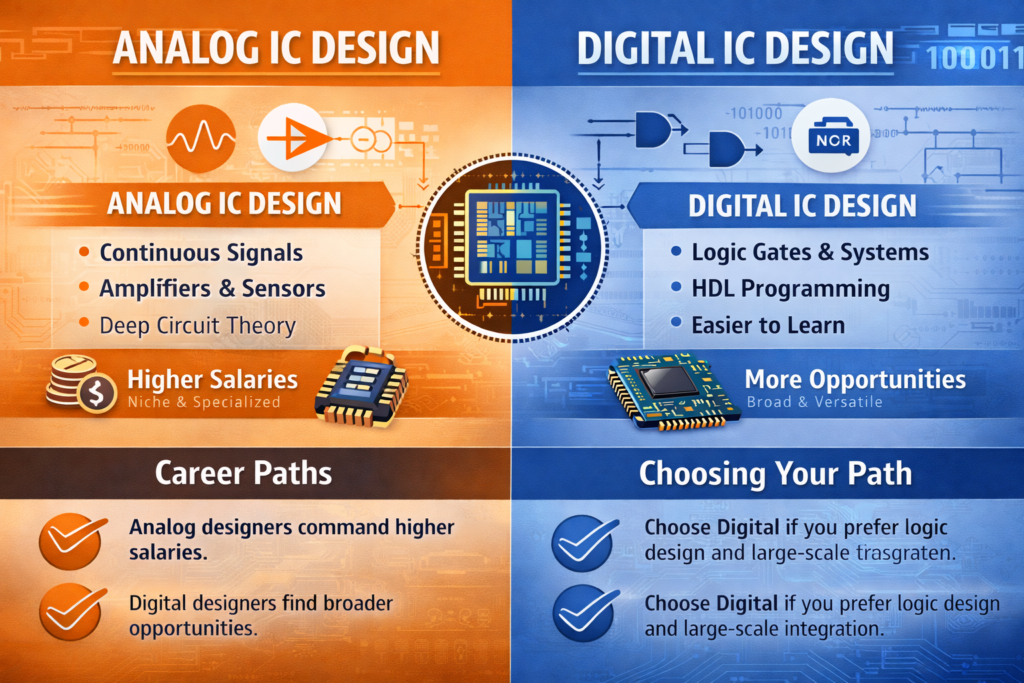
Analog design deals with continuous signals — such as amplifiers, filters, and sensors. It requires deep knowledge of device physics, noise, and analog verification techniques.
Digital IC Design
Digital design focuses on logic gates, finite state machines, and digital systems. It relies heavily on hardware description languages (HDLs) like Verilog and tools like ModelSim.
Career Paths
Analog designers often command higher salaries due to the complexity and niche nature of their work. Digital designers can find broader opportunities but must often compete with a larger talent pool.
Choosing Your Path
Choose analog if you enjoy deep circuit theory, precision, and real-world signal challenges. Choose digital if you prefer logic design and large-scale integration.
Conclusion
Both paths offer rewarding careers. Understand your strengths, gain the right skills, and target internships or projects that align with your chosen track.